Project Management
- Strategy, Systems
Project Management is the process of planning, executing, and controlling projects to achieve specific goals and objectives. It involves coordinating resources, managing risks, and ensuring that projects are completed on time, within budget, and to the required quality standards. It is a separate discipline from general management as it serves finite projects with defined deadlines. It is a critical function for any organisation which has project based work.
Numerous project management methodologies have been developed, to provide frameworks for managing projects of different types and sizes and in different industries. Largely these all involve
five key stages:
1. Initiation: Before beginning to plan a project its potential value is assessed and stakeholder buy-in is secured via the development of a Business Case, which outlines the project's
objectives, scope, and expected outcomes.
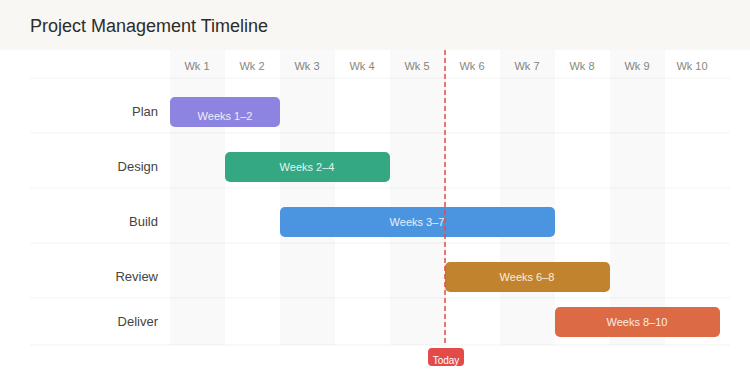
2. Planning: Once the project go-ahead is confirmed a detailed project plan is developed. This outlines the tasks, timelines, resources, and budget required to
complete the project. Deadlines and owners are assigned to all tasks. This stage also involves identifying potential risks and developing contingency plans to mitigate
these risks.
3. Execution: After planning the project plan is put into action, kicking off at the scheduled time. Resources are allocated, tasks are completed, and progress
is monitored.
4. Monitoring and Controlling: For almost all projects, there will be some deviation from the plan as work progresses. Performance against the plan has to be
continually monitored to identify these deviations and take corrective actions as needed.
5. Closure: The final stage involves completing all project activities, delivering the final product or service, and formally closing the project. This includes
evaluating the project's success, documenting lessons learned, and releasing resources.
The numerous project management methodologies can broadly be categorised as Standard or Adaptive:
Standard Methodologies:
Also known as Predictive or Waterfall methodologies, these follow a linear sequential approach to project management, mapping out the entire project from start to finish
before a project begins. Each phase of the project is completed before moving on to the next, with little to no overlap between phases, and any changes require formal
approval as they disrupt the established plan. This approach is best suited for projects with well-defined requirements and a clear path to completion, where changes
are unlikely to occur, with suitable industries being construction, manufacturing and engineering.
Adaptive Methodologies:
Also known as Iterative or Agile methodologies, these follow a more flexible approach to project management. They allow for changes and adjustments throughout the
project lifecycle, with work being completed in smaller increments or sprints. This approach is best suited for projects with evolving requirements and a high degree
of uncertainty, where changes are likely to occur, with suitable industries being software development, marketing and creative projects.